
You will agree with me that LED technology has transformed the way we experience lighting today. Among the many LED options available, 48V LED lights have recently gained special attention. They offer stable, smooth illumination that makes any space look impressive. But what exactly does “48V” mean? Why is it preferred in specific projects? This guide to 48V LED lights will answer all these questions in simple terms. I will also explore its main types —DMX Strip, Wall Washer, Tube & Neon Options — in detail. So, let’s get started!
What Are 48V LED Lights & What Does “48V” Mean?
48V LED lights are a type of lighting system that operates on 48 volts of direct current (DC). 48V indicates the voltage these LED lights use. In simple terms, they use a slightly higher voltage than the standard 12V or 24V LED lights. This higher voltage helps the lights perform better in large or long lighting setups. Because the voltage is higher, the electric current flowing through the wires is lower.
This reduces power loss and allows the LED light to shine evenly across longer distances. As you can see in regular low-voltage lights, brightness can drop if the strip runs too long. However, this problem is eliminated in 48V LED lights. These lights, due to their higher voltage, can cover a large area without compromising brightness.
Another significant advantage of 48V LED systems is their energy efficiency. As I said above, the higher voltage means less current passes through the wires. In simple words, 48V LED lights use less current, which means less heat is produced and less energy is wasted. This allows the 48V LED lights to stay cool, perform efficiently, and last longer. This is why 48V LED systems have become the preferred choice in architectural and stage lighting.
48V DMX LED Strip Lights
48V DMX LED strip lights are long, flexible strips with many small LED bulbs arranged in a row. These strips are bendable, that’s why you can fit them anywhere, like ceilings, long walls, or edges. The 48V means these LED strip lights operate at a constant 48V. As a result, they can cover large areas with even brightness.

However, the DMX (Digital Multiplex) in the LED strip lights is a digital control system. It allows you to control the lights—changing colors, brightness, and patterns—using a special controller. In simple words, DMX works like a “remote brain” for the lights. You can connect your LED strip lights to the DMX controller and create lighting effects according to your choice.
Pros
- 48V DMX strip lights provide even, bright lighting over long distances.
- Offer complete color control with DMX.
- Uses less electricity compared to traditional lighting.
- Offer sync with music or scenes.
Cons
- Comes at a higher initial cost.
- Always need a controller for lighting effects.
- Initial setup can be tricky.
- Extra parts, such as power supplies, connectors, and DMX cables, are required.
48V LED Wall Washer Lights
48V LED wall washer lights are specialized lighting fixtures designed to illuminate a wall. The name “wall washer” comes from the way these lights spread light. How? Actually, these lights spread the light evenly across a large wall, making it glow smoothly from top to bottom.

However, the 48V system again helps these lights to cover a large area with even brightness.
That’s why LED wall washers are used in architectural lighting, such as on building exteriors. Many 48V LED wall washers also come with DMX control. It means you can change colors, brightness, and effects. Another feature of LED wall washers is waterproofness. As you know, they are mainly used in exterior lighting. This feature helps them survive harsh rainy conditions.
Pros
- Spreads light evenly across large walls without dark spots.
- Perfect for outdoor use due to its weather resistance.
- Durable and long-lasting, as they are made with strong materials like aluminum.
- Gives walls a professional appearance.
Cons
- Higher upfront cost.
- Installation requires careful attention to even lighting effects.
- Not ideal for small walls.
- Requires proper wiring for a long run.
48V DMX Tube Lights
48V DMX tube lights are straight, rod-shaped lights that use 48V to illuminate a space. They mainly look like traditional fluorescent tube lights. However, what sets them apart is the use of DMX technology and higher voltage. The 48-volt voltage makes DMX LED tubes evenly spread light over a considerable distance.
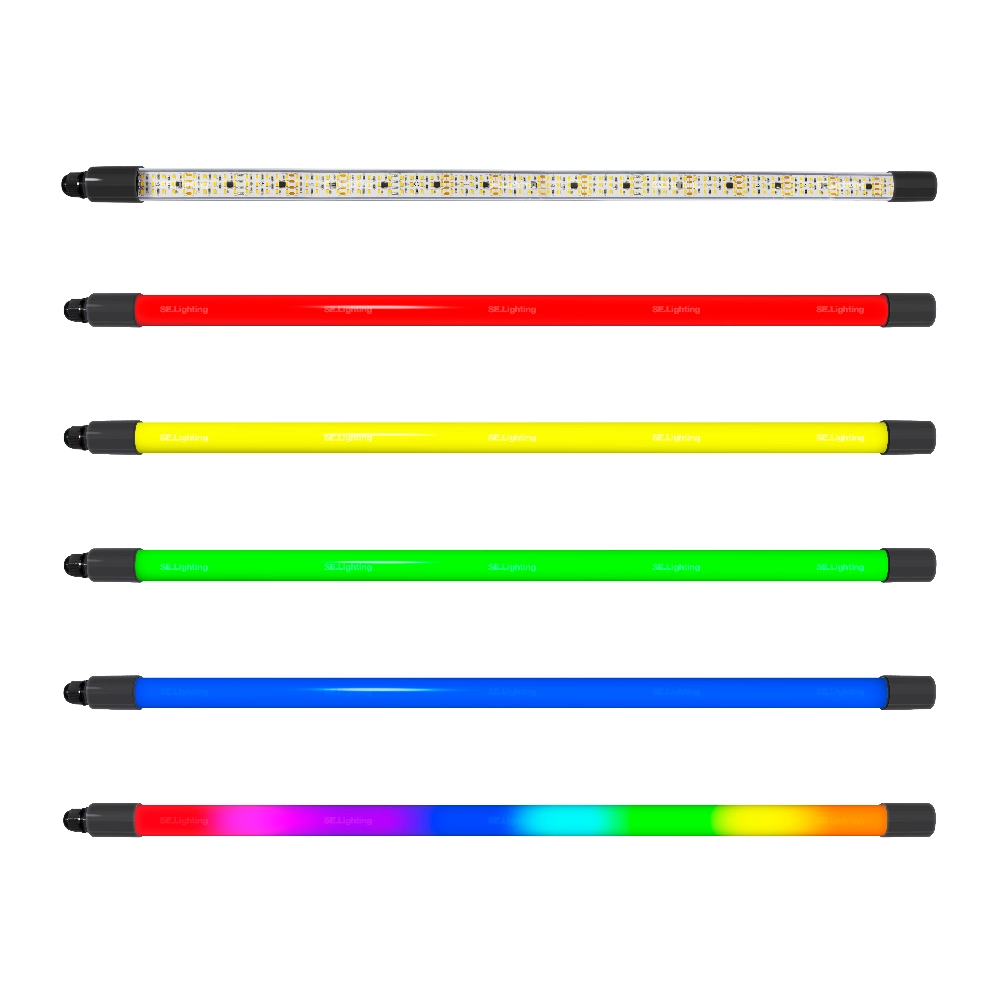
These tube lights are available in different color temperatures. DMX control allows you to adjust the operation of these lights. You can easily manage their effects, brightness, how fast the lights change their color, and so on. Additionally, you can also choose warm white, cool white, or daylight based on your preferences.
Pros
- Safer and provide consistent voltage (no voltage drop)
- Provide bright and stable lighting effects.
- Uses less electricity than traditional fluorescent tubes.
- Slim, lightweight and Offer multiple color options.
Cons
- Requires a 48V DC driver to work correctly.
- May not fit into traditional fluorescent fixtures.
- More expensive than ordinary fluorescent tubes.
48V LED Neon Lights
48V LED neon lights are a modern lighting solution that has replaced the traditional neon signs. As you can see, old neon signs are made with glass and use neon gas. Therefore, they cannot be bent and are challenging to install. However, the LED neon lights are made from flexible silicone or PVC, which holds tiny LED chips.

This material allows them to bend into any shape you want, like letters or symbols. Moreover, LED neon lights are durable and energy-efficient. They are generally IP65 or higher rated. This rating shows they are waterproof and long-lasting in harsh outdoor conditions. That’s why you can mainly find LED neon lights in building outlines and store signage.
Pros
- Flexible and easy to shape due to its PVC composition.
- Low heat generation makes them safe to handle.
- Weather-resistant due to UV and water protection.
- Customizable effects with DMX control.
Cons
- Not suitable for bright task lighting.
- Limited repair options after damage.
- Some skills are needed for cutting and connecting.
- Offer a softer glow and a limited brightness range.
Key Installation & Planning Tips for 48V LED Systems
First, you have to choose the right type of 48V LED lights. Once done, it’s essential to plan your setup correctly. Proper planning not only saves time and effort but also helps your lights perform at their best. So, let’s look at some key tips to help you install and plan your 48V LED system the right way.
1- Check Power Supply & Wiring
When working with 48V LED lights, the power supply and wiring are crucial. A power supply is the device that converts regular AC power into 48 volts of direct current (DC). This is the voltage your 48V LED lighting setup needs. So, you should always make sure your power supply can handle the total wattage of all the LED lights connected.
If the supply is weak, your LED lights might flicker over time. Besides the power supply, you should also consider proper wiring. I recommend using thick, high-quality wires for 48V systems. These wires can carry the voltage safely over longer distances. However, thin or poor-quality cables can cause a voltage drop, dimming your LED lights.
2- Heat Management & Ventilation
Even though LED lights are energy-efficient, they can still produce some heat. If LEDs get too hot, their brightness can drop, and colors may change slightly. That’s why proper heat ventilation is essential to keep your 48V LED lights working safely. For this, you should install LED lights in areas with good air circulation. Also, avoid closed or tightly packed spaces where heat can build up.
Moreover, I recommend mounting LED strip lights on the metal surfaces. WHY? Because the metal naturally dissipates heat, which keeps the LED lights cool. However, many LED lights also come with a fixture that has built-in heat sinks. For an indoor 48V LED setup, I suggest you prefer these fixtures.
3- Control Systems
Control systems are what make 48V LED lights so versatile. They let you manage how your lights behave, including brightness, colors, and light effects. One of the most popular control options is the DMX system. You can install it in any type of LED light. However, when setting up your control system, make sure it is compatible with 48V LEDs. Moreover, ensure that the control system supports the total power and number of lights in your project.
4- Environmental Considerations
When planning your 48V LED lighting system, it’s essential to consider environmental conditions. No doubt, LEDs are durable and long-lasting. However, their performance can still be affected by factors such as temperature, humidity, dust, and water exposure. Therefore, you should understand your surroundings and choose the right type of LED light.
For example, for outdoor installations, you should choose waterproof 48V LED lights. For this, look for an LED light with a high IP rating, like IP65, IP66, or IP68. These numbers show how well the LED light is protected against dust and water.
Frequently Asked Questions
Can I use a 24 V LED strip in a 48 V system?
No, you should not use a 24V LED strip in a 48V system. The higher voltage will overload and burn the LEDs almost instantly. Remember, each LED strip is designed to work with a specific voltage. So, always match the power supply voltage (48V) with the LED strip rating (48V).
Can I dim 48V LED lights?
Yes, you can dim 48V LED lights, but only if they are dimmable. Many 48V LEDs work with DMX controllers or PWM dimmers. These systems allow you to adjust brightness smoothly. But remember, not all 48V LEDs support dimming. Therefore, it’s essential to check the product specifications.
Are 48V lights more expensive?
Yes, 48V LED lights are usually more expensive at first because they use higher-quality parts. However, they offer greater efficiency, lower voltage drop, and a longer lifespan. This saves your money over time and makes them cost-effective over the long run.
Conclusion
The 48V LED lighting system has become one of the most popular choices today. It offers excellent stability and energy efficiency. Not only this, but these high-voltage LED lights can run for long distances without brightness loss. The high voltage reduces current consumption, making LED lights more energy-efficient. However, these lights come in several types, each specific to different purposes.
Those include 48V DMX LED strip lights, wall washers, tubes, and neon lights. You can choose from these LED types based on your needs. However, when installing any of these lights, make sure they are connected to the correct power supply. Also, install LED lights in well-ventilated areas to extend their lifespan. Lastly, check the IP rating of LED lights if you are buying for outdoor use.