
LED strip lights are thin, bendable lights that people use to make homes, shops, and events look bright and colorful. You may have seen them under kitchen shelves, around TV screens, on ceilings, or even outside for parties. Many people like LED strips because they can change colors, can be dimmed, and are easy to set up. But there is one question that comes up often: Do LED strip lights use a lot of electricity?
The short answer is no. They use far less electricity than old-style light bulbs. But there is more to know if you want to understand how much they cost to run and how to save even more power.
In this guide, I will talk about:
- How LED strip lights work
- How much power they use
- How they compare to other lights
- What can change their electricity use
- Tips to save power
- Extra facts and FAQs
By the end, you’ll know exactly if LED strips are right for you.
A Quick Brief About LED Strip Lights
LED strip lights are made up of many small LED bulbs fixed on a thin, flexible strip. LED stands for Light Emitting Diode. These tiny diodes light up when electricity passes through them.

The strip usually has a sticky back so you can attach it anywhere, along shelves, under cabinets, behind TVs, or around windows. Some LED strips can even be cut to fit a certain length or joined together to make them longer.
LED strip lights come in many colors:
- Single-color strips (like warm white or cool white)
- RGB strips (Red, Green, Blue, and can mix colors)
- RGBW strips (RGB plus White)
- Smart LED strips (can connect to Wi-Fi or apps for control)
How Much Electricity Do LED Strip Lights Use?
The amount of electricity something uses is called power consumption. It is measured in watts (W).
LED strip lights use between 4 to 25 watts per meter, depending on the type and brightness.
Here’s an example:
- A 1-meter LED strip using 5 watts = 0.005 kilowatts (kW)
- If you run it for 10 hours: 0.005 × 10 = 0.05 kilowatt-hours (kWh)
If your electricity costs $0.16 per kWh (about the US average in 2025), the cost is:
0.05 × $0.16 = $0.008
That means it costs less than 1 cent to run that 1-meter strip for 10 hours!
Now compare that to an old 60-watt bulb:
- 60 watts ÷ 1000 = 0.06 kW
- 0.06 × 10 hours = 0.6 kWh
- 0.6 × $0.16 = $0.096
The old bulb costs about 12 times more to run than the LED strip.
Why Do LED Strip Lights Use Less Energy?
LEDs are very efficient because they use most of the electricity to make light instead of heat. This means almost all the power they take in becomes useful light for your room. Old incandescent bulbs are very different, they waste most of their electricity by making heat, which is why they get so hot when you touch them. That wasted heat also means they use more power to give the same amount of light.
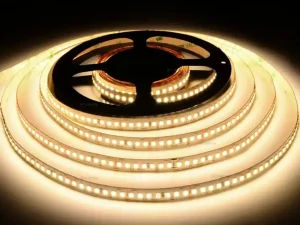
LED strip lights do not have this problem. They stay cool and give you more light for the same amount of electricity. This is one big reason why people do not usually worry about how much electricity LED strip lights use. They are designed to give bright light while using the smallest amount of power they can.
A quick comparison:
| Light Type | Watts for same brightness | Heat Produced |
|---|---|---|
| Incandescent bulb | 60 W | High |
| CFL bulb | 14 W | Medium |
| LED bulb/strip | 5–10 W | Low |
This efficiency is why LED strips can stay cool, last longer, and cost much less to run.
Do LED Light Strips Use a Lot of Electricity Compared to Other Lights?
No, they do not. In fact, even a long LED strip will often use less electricity than one bright old bulb.
Example:
- A 10-meter LED strip (60 watts total) used for 5 hours → 0.3 kWh
- A 100-watt bulb used for 5 hours → 0.5 kWh
So if someone asks, do LED strip lights use a lot of electricity, you can say no, even though the strip has many tiny lights, it still uses less power than a single old bulb.
Factors That Change Power Use
Not all LED strips are the same so if you are worried about do led strip lights use a lot of electricity, stop panicking and start calculating. The electricity they use can change depending on:
- Brightness: Brighter settings use more power. Many LED strips let you dim the light to save energy.
- Length: The longer the strip, the more LEDs, and the more electricity it will use.
- Color: White and bright colors often use slightly more power than deep colors like red or blue.
- Quality: High-quality LEDs are more efficient. Cheap ones may use more power and not last as long.
How to Measure Your LED Strip’s Electricity Use?
You can find out exactly how much electricity your strip uses in three ways:
- Check the packaging: It will list watts per meter.
- Use a power meter: Plug your LED strip into a power meter to see real-time use.
- Do the math: Multiply watts by hours used, divide by 1000 to get kWh.
Example: A 50-watt strip used for 6 hours= (50 × 6) ÷ 1000 = 0.3 kWh.
This makes it easy to answer the question, do LED strip lights use a lot of electricity, with real numbers based on your own setup.
Ways to Save More Electricity with LED Strip Lights
People often ask, do LED strip lights use a lot of electricity? The answer is no, but you can make them use even less. Here’s how:

- Use a timer so they turn off automatically after a set time.
- Lower the brightness when you don’t need them very bright.
- Turn them off when no one is in the room.
- Use motion sensors so they only turn on when you walk by.
- Buy good quality strips that give the same light with less power.
- Pick solid colors instead of flashing effects, which use more power.
- Use only as much strip as you need, shorter strips use less electricity.
These simple steps keep your lights fun while saving more energy and money.
How Long Do LED Strip Lights Last?
Most good LED strips last 25,000 to 50,000 hours.
If you use them for 5 hours daily:
- 25,000 ÷ 5 = 5,000 days → over 13 years of life
This long life means you save not just on electricity but also on replacement costs. And since do LED strip lights use a lot of electricity is a common question, remember that their low power use and long lifespan make them one of the most cost-effective lighting options you can choose.
Environmental Benefits
Because LED strips use less power, they lower the demand on power plants. This means less fuel is burned, less carbon dioxide is released, and the planet stays cleaner.
LED Strip Lights vs Other Lighting Choices
- Incandescent Bulbs: Very bright but waste a lot of energy as heat
- CFL Bulbs: Better than incandescent but contain mercury
- LED Bulbs and Strips: Most efficient, safe, and flexible for decoration
LED strips can be bent, cut, joined, and even controlled by apps, making them more versatile than regular bulbs.
Do LED Strip Lights Really Use a Lot of Electricity?
No! LED strip lights are one of the most efficient lighting options you can use. Even if you use them for hours daily, the cost is low, often just a few rupees per day.
They are bright, long lasting, safe, and can make any space look better without making your electricity bill high. By using timers, dimmers, and high quality strips, you can enjoy colorful, beautiful light and save money at the same time.
FAQs
Can LED strips run all night?
Yes, they can, and they will use very little electricity. But using a timer saves even more.
Do LED strips overheat?
Not usually, unless they are low-quality or placed where air cannot move.
Can I cut LED strips?
Yes, most can be cut at marked points. Follow instructions carefully.
Are LED strips safe?
Yes, if you use them properly and do not overload them.
Do LED strips work outside?
Yes, but you must use waterproof types for outdoor areas.